
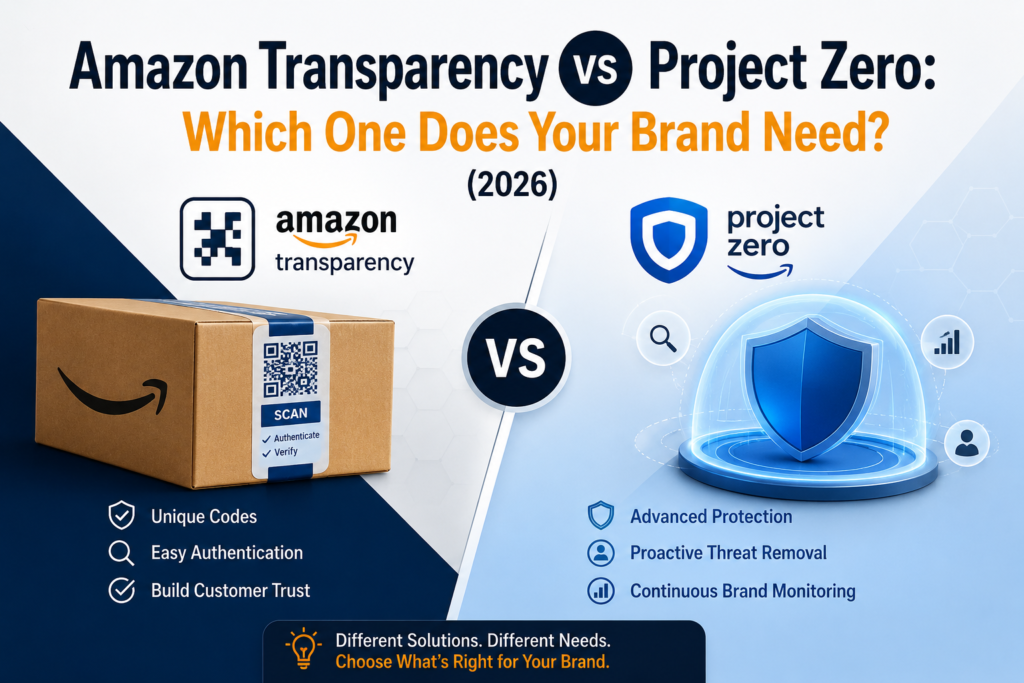
If you’ve been researching how to protect your brand on Amazon, you’ve almost certainly come across both the Amazon Transparency Program and Amazon Project Zero. They both promise to fight counterfeits. They’re both run by Amazon. And they’re both recommended by brand protection experts.
So why are they two separate programs? What’s actually different about them? And which one does your brand need right now?
The confusion is understandable — but the answer matters. Choosing the wrong program (or skipping both) can leave serious gaps in your brand’s protection and cost you far more in lost sales than the tools would ever cost to implement.
Let’s break it all down clearly.
Quick overview: what are they?
Before diving deep, here’s the essential difference in plain English:
Amazon Transparency
Stops fake products from reaching customers by applying unique serialization codes to every unit you manufacture. Amazon scans the code before shipping — no code, no sale.
Cost: Per-unit label fee
Amazon Project Zero
Finds and removes counterfeit listings already live on Amazon. Gives you self-service removal, automated scanning, and optional serialization — all in one free program.
Cost: Free
Think of it this way: Project Zero is your rapid response team — it finds and removes threats that are already active. Transparency is your fortress wall — it stops threats from getting through in the first place. One is reactive, one is proactive. Both matter.
What is the Amazon Transparency Program?
Amazon Transparency is a unit-level product authentication program. Every single unit you produce gets a unique alphanumeric T-mark code — a scannable label — applied during manufacturing or packaging.
Here’s what makes it powerful:
- At Amazon’s fulfillment centers: When your inventory arrives, Amazon scans every unit’s T-code before it can be stored or shipped. Any unit without a valid, registered code is rejected — it physically cannot enter Amazon’s fulfillment network.
- After purchase: Customers can scan the T-code using the Amazon Shopping app to verify their product is genuine. This builds trust and gives buyers confidence that what they received is the real thing.
- For FBM sellers: Transparency codes can also be used on seller-fulfilled orders, extending protection beyond FBA.
The program is available across Amazon’s major marketplaces including the US, UK, Germany, France, Italy, Spain, India, Canada, and Japan.
What is Amazon Project Zero?
Project Zero is an advanced brand protection program for sellers already enrolled in Amazon Brand Registry. It operates across three pillars:
- Automated protections — Amazon’s machine learning scans listings 24/7 using your brand attributes and proactively removes suspected counterfeits before you even see them
- Self-service counterfeit removal — you can remove counterfeit listings yourself instantly, without filing a report and waiting for Amazon to act
- Optional serialization — similar to Transparency, but as an add-on feature rather than the core purpose
For a complete breakdown of how Project Zero works and how to enroll, see our dedicated guide: Amazon Project Zero: How It Works and Is It Worth It?
Transparency vs Project Zero: full comparison
| Feature | Transparency | Project Zero |
|---|---|---|
| Primary purpose | Prevent fakes reaching customers | Remove existing counterfeit listings |
| How it works | Serialized codes on every unit | Automated scan + self-service removal |
| Cost | Per-unit label fee ($0.01–$0.05) | Free (serialization optional) |
| Requires Brand Registry | ✓ Yes | ✓ Yes |
| Customer verification | ✓ Customers can scan to verify | ✗ No |
| Works at fulfillment stage | ✓ Amazon scans before shipping | ✗ No |
| Removes live listings | ✗ No | ✓ Instantly, self-service |
| Automated listing scan | ✗ No | ✓ 24/7 continuous |
| Operational complexity | High — labels on every unit | Low — digital dashboard only |
| Setup speed | Weeks (manufacturing coordination) | Days (after Brand Registry approval) |
| Best for | High-value, high-risk products | Brands with active counterfeit problem |
How Amazon Transparency works in practice
Understanding the workflow helps you decide whether Transparency fits your operation. Here’s the real-world process from enrollment to customer verification:
How Amazon Project Zero works in practice
Project Zero is significantly easier to get running. Once you’re approved through Brand Registry, the workflow is almost entirely digital:
Which one should your brand choose?
The right answer depends on your situation right now. Here’s a clear decision framework:
🔐 Choose Transparency if…
- You sell high-value products where a single counterfeit wave causes serious damage
- You’re in a high-risk category — supplements, electronics, luxury goods, cosmetics
- You have control over your manufacturing or labelling process
- You want customers to be able to verify authenticity themselves
- Your margins can absorb the per-unit label cost
- Counterfeiting is a known, ongoing problem for your specific products
🛡️ Choose Project Zero if…
- You’re dealing with active counterfeit listings right now and need fast removal
- You want free, automated 24/7 scanning without operational changes
- You don’t yet have the manufacturing setup to add serialization labels
- You’re in an earlier stage of growth and cost is a serious factor
- You want to get protection running in days, not weeks
⚡ Use both if…
- Your brand is established and counterfeiting is a serious, ongoing threat
- You sell high-value products at meaningful volume where label costs are justified
- You want layered protection — remove what’s live AND prevent fakes reaching customers
- You’re in categories where customer trust and product authenticity are critical selling points
The cost breakdown
Cost is one of the most important factors when deciding between the two programs — especially for growing brands watching their margins carefully.
Amazon Transparency — cost breakdown
Amazon Project Zero — cost breakdown
ROI framing: A single counterfeit wave that steals your Buy Box for a week, collects negative reviews, and forces you to run a price-matching campaign can easily cost thousands of dollars. For most brands, the cost of either program is a fraction of what a serious counterfeit problem costs to recover from.
Frequently asked questions
Do I need both Transparency and Project Zero?
Not necessarily — but the most protected brands use both. Project Zero handles removal of live counterfeits while Transparency prevents fakes from reaching customers entirely. If budget is a constraint, start with Project Zero since it’s free and get Transparency in place as your brand and margins grow.
Can I enroll individual ASINs in Transparency, or does it have to be my whole catalogue?
You can enroll individual ASINs — you don’t have to apply Transparency across your entire product catalogue. This makes it practical to start with your highest-value or highest-risk products and expand from there.
What happens if a customer scans a Transparency code and it’s fake?
If a customer scans a code that isn’t registered (or is a duplicate), the Amazon app flags it as potentially counterfeit and prompts them to report it. Amazon investigates and takes action against the seller. This also gives you valuable intelligence about where counterfeits are getting through your supply chain.
Is the Amazon Transparency Program available worldwide?
Transparency is available in major Amazon marketplaces including the US, UK, Germany, France, Italy, Spain, India, Canada, Japan, and others. Availability varies by region and Amazon continues to expand the program. You’ll need to enroll separately for each marketplace.
Can small sellers use Transparency or is it only for big brands?
Any seller enrolled in Brand Registry can apply for Transparency regardless of size. However, the per-unit label cost and operational complexity of applying codes during manufacturing make it more practical for sellers with established supply chains and sufficient margins. Smaller sellers often find Project Zero a better starting point.
Does Project Zero replace the need for Transparency?
No. Project Zero removes counterfeit listings — it doesn’t prevent fake physical products from entering Amazon’s fulfillment network. A counterfeit seller could theoretically ship fake products under a new listing before Project Zero’s scanning catches it. Transparency closes that gap by authenticating at the unit level before anything ships to a customer.
Want to see every brand protection tool Amazon offers?
Transparency and Project Zero are just two pieces of the puzzle. See all 7 Amazon brand protection services that top sellers use to protect their revenue — compared side by side.
See All 7 Services →The bottom line
Amazon Transparency and Project Zero aren’t competitors — they’re complements. They protect your brand at two completely different stages of the counterfeit problem.
Project Zero is your fast-response system. The moment a counterfeit listing appears on Amazon, automated scanning flags it and you can remove it yourself within minutes. It’s free, it’s powerful, and every Brand Registry seller should have it.
Transparency is your physical barrier. Even if a counterfeit listing somehow slips through, the fake product cannot be shipped to your customers — because it won’t have a valid serialization code. It costs more to implement, but for high-value brands in high-risk categories, it’s close to bulletproof.
The brands losing the most money to counterfeits on Amazon are the ones who thought “I’ll sort that out later.” Later always costs more. Start with Project Zero today — it’s free and takes days to set up. Then build toward Transparency as your brand grows.
Related reading
- 7 Amazon Brand Protection Services That Save Millions
- How to Enroll in Amazon Brand Registry: Complete Walkthrough
- Amazon Project Zero: How It Works and Is It Worth It?
- How to Report Counterfeit Products on Amazon: 5 Methods
- Amazon IP Accelerator vs Brand Registry: What’s the Difference?

One thought on “Amazon Transparency vs Project Zero: Which One Does Your Brand Need? (2026)”