
Amazon Transparency vs Project Zero comes down to timing. Project Zero removes counterfeit listings that are already live on Amazon. Transparency stops counterfeits from reaching customers in the first place by verifying a unique code on every unit before it ships. Project Zero is free to join; Transparency costs a few cents per code and requires codes on every unit you sell. Most brands start with Project Zero; brands with high-value or frequently copied products add Transparency. Many established brands use both.
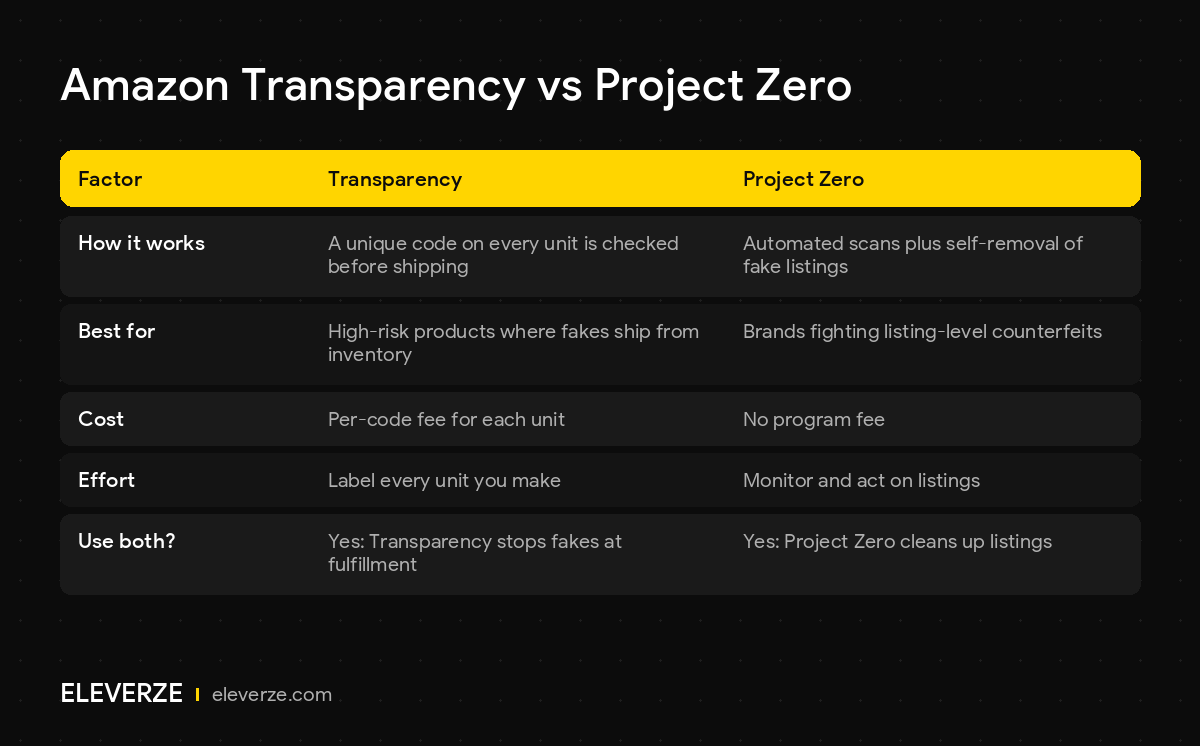
Table of Contents
Amazon Transparency vs Project Zero: quick comparison
| Project Zero | Transparency | |
|---|---|---|
| What it does | Removes counterfeit listings (automated + self-service) | Verifies every unit with a unique code before shipping |
| When it acts | After a counterfeit is listed | Before a counterfeit reaches a customer |
| Cost | Free (optional serialization extra) | Per-code fee, a few cents per unit |
| Packaging changes | None (unless you serialize) | A code on every unit |
| Requirements | Brand Registry, accurate reporting history | Brand Registry, product barcodes (GTIN/UPC), ability to apply codes |
| Customer-facing | No | Yes: shoppers can scan codes to verify authenticity |
What is the Amazon Transparency program?
Transparency assigns a unique code to every unit of an enrolled product. You apply the codes during manufacturing or packaging. Before any unit ships from Amazon or from a seller, the code is checked; units without a valid code are stopped. Shoppers can also scan codes to confirm a product is genuine. Because every seller must supply valid codes, counterfeits of enrolled products can’t be fulfilled through Amazon. Amazon’s Transparency page has the current details. Transparency codes are separate from the FNSKU label that FBA uses to track which seller a unit belongs to.
What is Amazon Project Zero?
Project Zero uses your brand data to remove suspected counterfeits automatically and gives approved brands a self-service tool to remove counterfeit listings themselves. It works on listings that already exist (see Amazon’s Project Zero page). Project Zero explained.
Which one should your brand choose?
Start with Project Zero if
- Counterfeits appear occasionally and you want faster removal
- You can’t change packaging right now
- You want protection at no added cost
Add Transparency if
- Counterfeiting is constant, and fakes keep reappearing despite removals
- Your products are high-value or safety-sensitive (supplements, cosmetics, electronics, baby products)
- You control manufacturing well enough to apply a code to every unit
Use both if
You’re an established brand under persistent attack. Transparency prevents fakes reaching customers; Project Zero cleans up listings that slip through for products not yet enrolled.
Example scenarios
A supplement brand with copycat bottles
Fakes look almost identical and carry safety risk. Project Zero removes the listings it can see, but counterfeits mixed into shared inventory can still ship. This is where the Amazon Transparency program earns its cost: no valid code, no shipment.
A home goods brand with occasional knock-offs
Counterfeits appear a few times a year on separate listings. Project Zero’s self-service removal handles this at no cost, and packaging stays unchanged.
An electronics accessory brand selling through distributors
Genuine and fake units mix in third-party supply chains. Transparency codes let Amazon tell them apart unit by unit, which listing removals alone can’t do.
In each case the Amazon Transparency vs Project Zero decision follows the same question: can the counterfeit be spotted on the listing, or only on the unit itself?
The cost breakdown
Project Zero membership is free. Transparency charges per code, with the per-code price falling as volume rises, plus the cost of printing and applying labels in your supply chain. Check Amazon’s current Transparency pricing for your volume before enrolling.
Amazon Transparency vs Project Zero FAQ
Can I use Transparency without Brand Registry?
No. Both programs require Brand Registry.
Does Transparency work for FBM sellers?
Yes. Seller-fulfilled orders of enrolled products also require valid codes.
Do I have to enroll my whole catalog?
No. You can enroll the products most at risk.
Is there a single Amazon counterfeit program that does everything?
No. Each Amazon counterfeit program covers a different stage: Brand Registry gives you reporting tools, Project Zero removes listings, Transparency verifies units and the Counterfeit Crimes Unit pursues offenders in court. Most well-protected brands combine at least two.
Need help protecting your brand?
Choosing the program is the easy part; using it consistently is where brands fall behind. Our partner DMCA Desk handles monitoring and enforcement for ecommerce brands. See all your options in Amazon brand protection services.


One thought on “Amazon Transparency vs Project Zero: Which One Does Your Brand Need? (2026)”