Amazon brand protection services are the tools and providers that stop counterfeits, hijackers and unauthorized sellers from taking your sales. Amazon offers several for free or at low cost (Brand Registry, Report a Violation, Project Zero, Transparency, IP Accelerator and the Counterfeit Crimes Unit), and outside providers handle monitoring and enforcement for you. Here are the seven Amazon brand protection services that matter and when to use each.
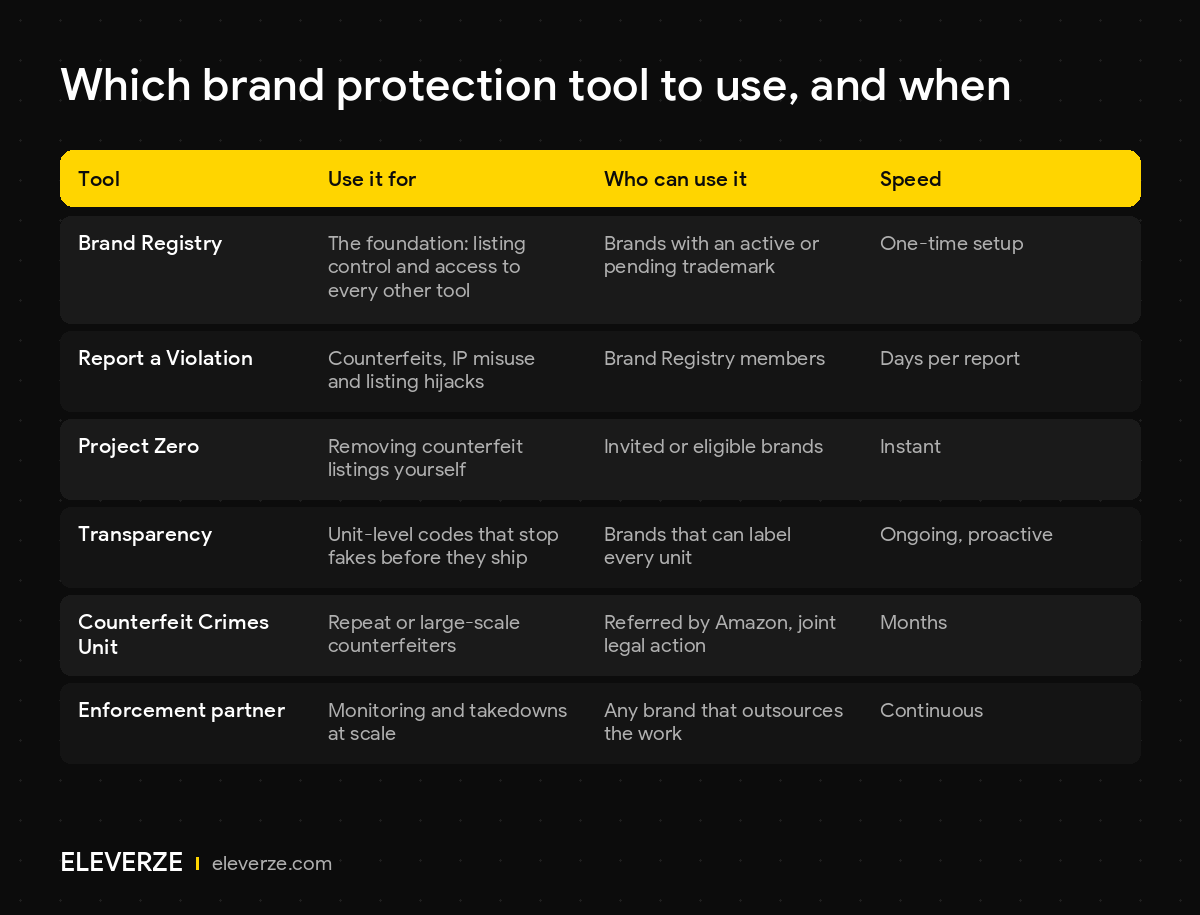
Table of Contents
Why brand protection matters on Amazon
Counterfeits and hijackers take sales from your listings, leave negative reviews on your ASINs and can trigger complaints that hurt your account health. Each sale lost to a fake also weakens the ranking your ads and listing work built. That is why Amazon brand protection services pay for themselves on any brand with real sales.
1. Amazon Brand Registry
The foundation of everything else. Brand Registry gives a trademark owner control over their listings, access to the Report a Violation tool, A+ Content, Brand Stores and Sponsored Brands. It’s free; you need a registered or pending trademark. Amazon’s Brand Registry page lists the current benefits. See our Brand Registry enrollment guide.
2. Report a Violation
The Brand Registry tool for reporting counterfeits, trademark and copyright infringement and other policy violations, with search tools to find suspect listings across Amazon’s stores. See how to report counterfeit products.
3. Project Zero
Automated protections that use your brand data to remove suspected counterfeits, plus a self-service tool that lets approved brands remove counterfeit listings directly, and optional product serialization. Project Zero explained.
4. Transparency
Unique codes on every unit that Amazon scans before shipping, so fakes never reach customers. It costs a few cents per code. See Transparency vs Project Zero.
5. IP Accelerator
Amazon’s network of vetted IP law firms that file trademarks at pre-negotiated rates, letting you join Brand Registry while your trademark is still pending. What IP Accelerator costs.
6. Counterfeit Crimes Unit
Amazon’s team that investigates counterfeiters, refers them to law enforcement and files joint lawsuits with brands. Amazon says it has pursued more than 32,000 bad actors since 2020 (see Amazon’s Counterfeit Crimes Unit page). See our counterfeit lawsuit case studies.
7. Third-party enforcement services
Amazon’s tools only work when someone uses them consistently. An Amazon brand protection agency monitors your listings daily, finds unauthorized sellers and counterfeits, files reports and takedowns, and escalates repeat offenders. For brands without in-house time for this, a provider is often the difference between tools that exist and protection that works. Our partner DMCA Desk provides this for ecommerce brands.
Which Amazon brand protection services do you need?
- Every brand: trademark plus Brand Registry.
- Occasional counterfeits or hijackers: Report a Violation, checked weekly.
- Recurring counterfeits: Project Zero.
- High-value or safety-sensitive products under constant attack: Transparency.
- Repeat offenders that keep returning: the CCU and legal action.
- No time to monitor: an enforcement provider.
How to choose an Amazon brand protection agency
- Do they monitor daily, or only act when you complain?
- Do they report on what they found and removed?
- Do they understand Amazon’s policies, so reports are accepted?
- Can they escalate to legal action when needed?
- Is pricing clear, and are you locked in?
What does an Amazon brand protection agency do?
An Amazon brand protection agency runs your enforcement for you. A typical service covers:
- Daily monitoring of your ASINs and brand name for new sellers, counterfeit listings and copied images.
- Global marketplace monitoring across Amazon US, UK, EU and other stores, and often other marketplaces and websites.
- Takedowns through Report a Violation, Project Zero and copyright and trademark notices.
- Unauthorized seller removal: test buys, distribution checks and letters to resellers.
- Escalation of repeat offenders to Amazon’s Counterfeit Crimes Unit or legal counsel.
- Reporting on what was found, removed and still open.
Brand protection agency vs software vs in-house team
| Agency | Software | In-house team | |
|---|---|---|---|
| Who does the work | The agency | You, with automated alerts | Your staff |
| Best for | Brands without time to enforce | Brands with staff who can act on alerts | Large brands with constant volume |
| Cost | Monthly fee | Subscription | Salaries and tools |
| Escalation and legal | Usually included or arranged | Not included | Depends on the team |
How much do Amazon brand protection services cost?
Amazon’s own tools are free, apart from Transparency codes (a few cents per unit) and trademark filing fees. Software subscriptions and agencies charge monthly, and the price depends on how many brands, ASINs and marketplaces you need covered and whether legal escalation is included. When comparing Amazon brand protection services, look at what is monitored, how often and what is reported, not at price alone.
How to protect your Amazon brand: a 5-step plan
- Register your trademark and enroll in Brand Registry.
- Lock down your listings: accurate brand data, strong images and A+ Content.
- Monitor your top ASINs weekly, or daily if counterfeits are common in your category.
- Report every violation with evidence, and keep your report acceptance rate high.
- Escalate repeat offenders, and consider Project Zero, Transparency or an enforcement partner like DMCA Desk.
Amazon brand protection services FAQ
Is Amazon Brand Registry enough to protect my brand?
It’s the foundation, but it doesn’t monitor or report for you. Someone still has to find violations and act on them.
What’s the difference between a hijacker and a counterfeiter?
A hijacker sells on your listing, often with fake or inferior goods. A counterfeiter makes fake versions of your product, sometimes on their own listings.
How much do brand protection services cost?
Amazon’s tools are free, except Transparency codes and trademark filing fees. Outside providers usually charge a monthly fee.