The fastest way to increase Amazon sales without spending more on ads is listing optimization, which raises three numbers at once: how often your product appears in search (impressions), how often shoppers click it (click-through rate) and how often visitors buy (conversion rate). Because sales multiply through all three, modest improvements in each compound. For example, 20% more impressions, a 20% higher click-through rate and a 20% higher conversion rate together produce about 73% more sales. Here’s how each lever works and what to change.
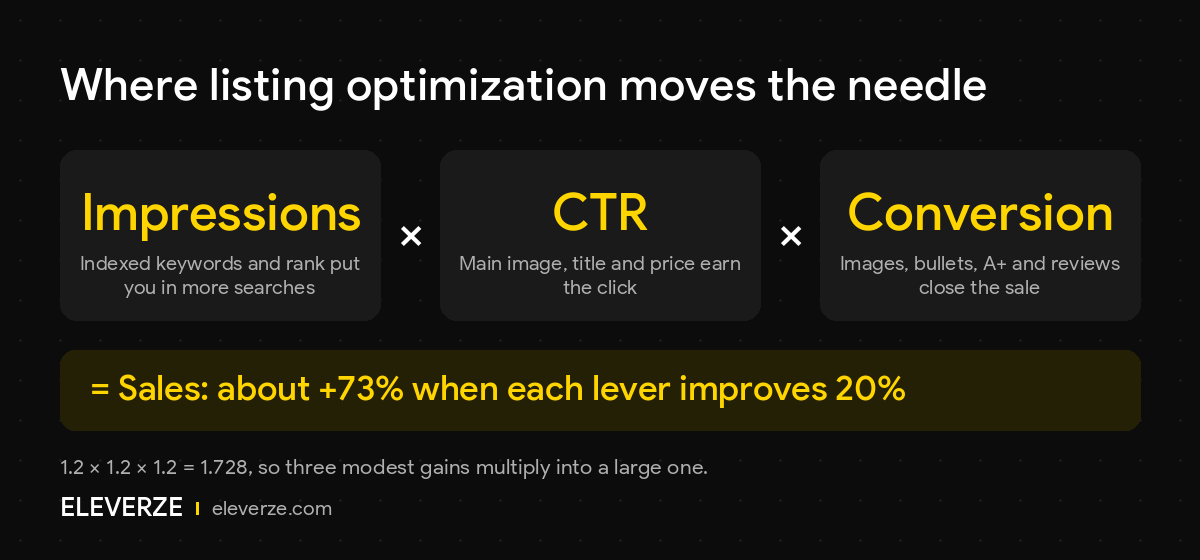
Table of Contents
The equation behind every effort to increase Amazon sales
Sales = impressions × click-through rate × conversion rate. Most sellers work on only one of these, usually impressions through ads. Listing optimization is the only lever that improves all three, and it makes every ad dollar more productive.
Lever 1: Impressions come from relevance
Amazon shows products it believes match the search. Your title, bullets and backend search terms tell Amazon which searches you’re relevant for. Missing keywords mean missing impressions, however good the product is. Start with thorough keyword research, then place the most valuable terms in your title.
Lever 2: Click-through rate comes from the search result
In search results, shoppers see your main image, the start of your title, price, star rating and review count, and any Prime or deal badge. To raise click-through rate:
- Make the main image fill the frame and stay clear at thumbnail size.
- Put the most important benefit or attribute in the first part of the title.
- Price competitively against the products shown beside you.
- Build ratings through Amazon’s Request a Review and Vine programs.
Lever 3: Amazon listing conversion rate comes from the product page
Once a shopper clicks, the page must remove doubt. Amazon’s own guide to boosting product listings covers the same ground. The highest-impact elements:
- Images: infographics answering size, fit and use questions, plus lifestyle shots.
- Bullets: benefits first, answering the objections in competitors’ reviews.
- A+ Content: comparison charts and brand story for brand-registered sellers.
- Reviews: rating and recent review content.
- Price and delivery: Prime eligibility and a competitive price.
5 quick listing fixes that increase Amazon sales
If you only have an afternoon, these changes usually move the numbers most:
- Reshoot or re-crop the main image so the product fills about 85% of the frame and reads clearly at thumbnail size.
- Move the main keyword and top benefit into the first 80 characters of the title, where mobile shoppers actually see it.
- Rewrite the first two bullets to answer the biggest objection in 3-star reviews, yours or a competitor’s.
- Add a size or comparison infographic, because “will it fit?” and “how is this different?” are the questions that stop most purchases.
- Fill the backend search terms with synonyms and alternate spellings you aren’t using on the page.
Each fix targets a different part of the sales equation. That’s why sellers who make all five tend to increase Amazon sales faster than sellers who only raise ad budgets.
Why better listings also lower ad costs
Amazon’s ad auction rewards relevance, which it measures largely through click-through and conversion. A listing that converts better wins placements at a lower cost per click and turns more clicks into sales, so ACoS falls from both sides. That’s why we always fix the listing before raising ad budgets. See how to reduce ACoS.
The ranking flywheel
More sales for a keyword lift your organic rank for it. Higher rank brings more impressions and sales, which lift rank further. Optimization starts the flywheel; advertising speeds it up.
How to measure the impact
In Seller Central Business Reports, track sessions and unit session percentage (your Amazon listing conversion rate) before and after changes. In Brand Analytics, track your click and purchase share for main keywords. Change one major element at a time so you can see what worked. For tools beyond Seller Central, see Amazon analytics tools to grow your sales.
How to increase Amazon sales: FAQ
How much can listing optimization increase sales?
It depends on how weak the original listing is. Listings missing key keywords or with poor main images usually see the biggest gains. Because sales multiply through impressions, clicks and conversion, improving all three compounds.
Which listing change has the biggest impact?
Usually the main image (click-through) and the title (relevance and click-through), followed by bullets and A+ Content for conversion.
Should I optimize before or after running ads?
Before, or at least at the same time. Ads sent to a weak listing cost more per sale, so optimizing first is the cheaper way to increase Amazon sales.
What is a good Amazon listing conversion rate?
It varies widely by category and price. Rather than chasing an industry average, compare your unit session percentage with your own history, and check your click and purchase share against competitors for the same keywords in Brand Analytics. If you win clicks but lose purchases, the product page is the problem.
For the full process, follow our step-by-step listing optimization guide, or have Eleverze optimize your listings.