
What Is Amazon PPC and Why It Matters
Understanding the Basics of Amazon Advertising
If you’ve ever searched for a product on Amazon and noticed listings labeled “Sponsored,” you’ve already encountered Amazon PPC (Pay-Per-Click) advertising in action. It’s one of the most powerful tools sellers use to get visibility in an increasingly crowded marketplace. Instead of waiting months for organic rankings, PPC lets you jump straight to the front of potential buyers.
Here’s the simple idea: you bid on keywords, your ad shows up, and you pay only when someone clicks. Sounds straightforward, right? But underneath that simplicity lies a highly competitive auction system where thousands of sellers are fighting for the same keywords.
In 2026, relying solely on organic traffic is almost impossible. Data shows that in many categories, top search results are dominated by sponsored listings, making PPC a necessity rather than an option.
Think of Amazon PPC like renting a prime storefront in a busy mall. Without it, your product might exist—but no one walks by to see it.
Why PPC Is Essential for New Sellers
For beginners, Amazon PPC isn’t just about sales—it’s about survival. When you launch a new product, you have zero reviews, no ranking, and no trust signals. PPC helps generate initial traffic and sales, which then improves your organic ranking.
Without PPC, your product is like a billboard in the desert—technically there, but completely ignored.
New sellers also use PPC to:
• Discover high-converting keywords
• Test product-market fit
• Build sales velocity quickly
The reality is simple: Amazon rewards products that sell. PPC jumpstarts that process.
How Amazon PPC Pricing Works
Cost-Per-Click (CPC) Explained
Amazon PPC operates on a cost-per-click (CPC) model. That means you only pay when someone clicks your ad—not when it’s displayed.
So, if your CPC is $1 and 100 people click your ad, you’ll spend $100. But here’s the catch: not every click turns into a sale.
That’s why CPC alone doesn’t tell the whole story. A $2 click might actually be cheaper than a $0.50 click if it converts better. It’s all about efficiency.
In 2026, the average CPC across Amazon is around $0.80 to $3.00, depending on competition.
The Auction System Behind Amazon Ads
Amazon PPC works like an auction. You set a maximum bid for a keyword, and Amazon compares it with other sellers bidding on the same term.
But here’s the interesting part—you don’t always pay your full bid.
Amazon uses a second-price auction system, meaning you typically pay just slightly more than the second-highest bidder.
This system rewards strategic bidding rather than just throwing money at ads. Smart sellers focus on:
• High-converting keywords
• Optimized listings
• Efficient bid adjustments
Average Amazon PPC Costs in 2026
CPC Benchmarks by Category
Amazon PPC costs vary wildly depending on your niche. Here’s what current data shows:
Competition Level Average CPC
Low competition $0.50 – $1.20
Medium competition $1.20 – $2.80
High competition $2.80 – $5.50
Ultra competitive $5.00 – $8.00+
Categories like electronics, supplements, and beauty tend to have the highest CPC due to intense competition.
This means your niche matters more than anything. Selling phone cases? Expect to pay premium prices. Selling niche pet accessories? Much cheaper clicks.
Cost Differences by Ad Type
Amazon offers multiple ad formats, each with different pricing:
Ad Type Average CPC
Sponsored Products $0.50 – $3.00
Sponsored Brands $1.00 – $5.00
Sponsored Display $0.30 – $2.00
Sponsored Products are the most popular because they convert best. Sponsored Brands are more expensive but great for building awareness
Daily and Monthly Budget Expectations
Beginner Budget Ranges
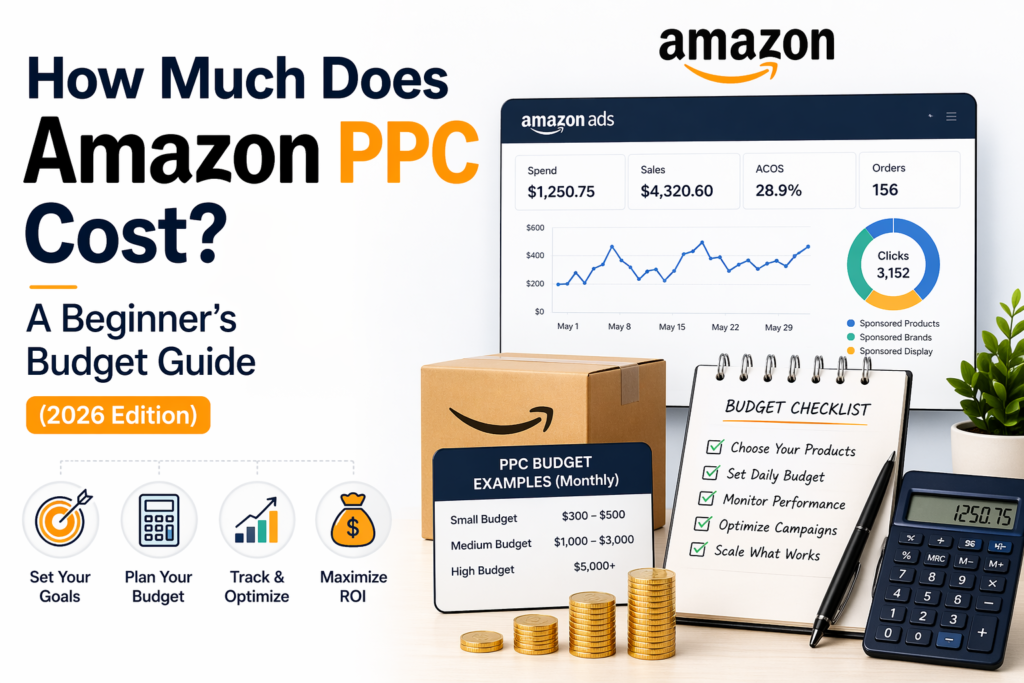
If you’re just starting, you don’t need thousands of dollars. Most beginners start with:
• $20 to $100 per day
• $500 to $3,000 per month
This budget allows you to:
• Collect data
• Test keywords
• Identify winning strategies
Think of this phase as “paid research.” You’re learning what works.
Scaling Budget for Growth
Once you find profitable campaigns, you scale. Growing brands typically spend:
• $100 to $500 per day
• $3,000 to $20,000+ monthly
At this stage, your focus shifts from testing to maximizing ROI.
Key Factors That Influence Amazon PPC Cost
Competition and Niche
Your niche determines everything. Highly competitive markets drive up bids, which increases CPC.
For example:
• Electronics = high cost
• Handmade or niche items = lower cost
More sellers = higher bids = higher costs.
Keyword Selection and Bidding Strategy
Broad keywords like “water bottle” are expensive. Long-tail keywords like “insulated stainless steel water bottle 1 liter” are cheaper and more targeted.
Smart sellers focus on:
• Long-tail keywords
• High-intent search terms
• Negative keywords to avoid waste
Understanding ACoS and Profitability
What Is ACoS?
ACoS (Advertising Cost of Sale) is the most important metric in Amazon PPC.
Formula:
ACoS = Ad Spend ÷ Ad Revenue
If you spend $100 and generate $500 in sales:
ACoS = 20%
Break-Even ACoS Explained
Your break-even ACoS equals your profit margin.
If your product margin is 30%, then:
• 30% ACoS = break-even
• Below 30% = profit
• Above 30% = loss
Understanding this is critical. Many beginners lose money simply because they don’t calculate margins properly.
Amazon PPC Campaign Setup Guide
Step-by-Step Campaign Creation
Setting up an amazon ppc campaign setup properly is the foundation of success. Here’s a simple beginner-friendly process:
1. Start with automatic campaigns
2. Collect keyword data
3. Move winning keywords to manual campaigns
4. Use match types (broad, phrase, exact)
5. Add negative keywords
This process helps you refine targeting over time.
Common Beginner Mistakes
Many beginners burn money because they:
• Use only broad keywords
• Ignore negative keywords
• Set unrealistic budgets
• Don’t optimize listings
Remember: PPC can’t fix a bad product page.
Tips to Reduce Amazon PPC Costs
Optimization Techniques
Reducing costs isn’t about spending less—it’s about spending smarter.
Key strategies:
• Improve product listing (images, title, reviews)
• Optimize keywords regularly
• Pause underperforming ads
• Focus on high-converting terms
Smart Budget Allocation
Instead of spreading your budget thin, concentrate on what works.
80/20 rule applies:
• 20% of keywords drive 80% of sales
Double down on winners.
Is Amazon PPC Worth It in 2026?
Pros and Cons
Pros:
• Instant visibility
• Scalable growth
• Data-driven insights
Cons:
• Rising costs (CPC increased ~12–18% yearly)
• High competition
• Requires constant optimization
Long-Term ROI Strategy
The goal isn’t just PPC sales—it’s organic ranking.
Use PPC to:
• Boost visibility
• Generate reviews
• Improve ranking
Then gradually reduce dependency.

One thought on “How Much Does Amazon PPC Cost? A Beginner’s Budget Guide (2026 Edition)”
Comments are closed.