The Complete Guide to Amazon SEO, Product Listing Strategy & Conversion Rate Optimization
What Is Amazon Listing Optimization?
Why Listing Optimization Is the #1 Sales Driver on Amazon
Before diving into tactics, it’s important to understand why Amazon listing optimization has such an outsized impact. Consider these facts:
• 70% of Amazon shoppers never scroll past the first page of search results
• The top 3 organic positions capture over 60% of all clicks
• A well-optimized listing can increase click-through rate (CTR) by 30–50%
• Improved conversion rates directly boost your organic ranking — creating a virtuous cycle
• Sellers using A+ Content report an average 8–15% increase in conversions
When you optimize your listing, you’re not just making it look better — you’re telling Amazon’s algorithm that your product deserves to rank higher. Higher rankings mean more impressions, more clicks, and more sales.
💡 Pro Tip: Even a 1% improvement in conversion rate can dramatically change your ranking and revenue trajectory on Amazon.
Step 1: Amazon Keyword Research — The Foundation of Optimization
Effective Amazon keyword research is the bedrock of every successful listing. Without the right keywords, even the most beautifully crafted listing will remain invisible.
Primary Keywords vs. Long-Tail Keywords
Your strategy should include both high-volume primary keywords and specific long-tail keywords. Primary keywords (e.g., “yoga mat”) drive volume, while long-tail keywords (e.g., “non-slip thick yoga mat for beginners”) drive highly targeted, purchase-intent traffic with less competition.
Tools for Amazon Keyword Research
• Helium 10 — Cerebro & Magnet tools for reverse ASIN lookups and keyword discovery
• Jungle Scout — Keyword Scout with search volume and competition data
• Amazon’s own search bar (autocomplete) — reveals real buyer search queries
• Competitor ASIN analysis — identify what keywords your top competitors rank for
• Amazon Brand Analytics — available to brand-registered sellers for search term reports
Semantic Keywords and LSI Terms
Beyond core keywords, semantic keywords (also called LSI — Latent Semantic Indexing — keywords) are related terms and phrases that help Amazon’s algorithm understand the full context of your product. For example, if your primary keyword is “protein powder,” semantic keywords include: whey protein, muscle recovery, post-workout supplement, high-protein shake, gym nutrition, and fitness supplement. Including these naturally throughout your listing significantly boosts your relevance scores.
💡 Pro Tip: Use at least 200–250 relevant keywords across your title, bullets, description, and backend search terms for maximum Amazon search coverage.
Step 2: Crafting the Perfect Amazon Product Title
Step 3: Bullet Points — Your Conversion Copywriting Engine
Step 4: Product Description & A+ Content
The product description is your opportunity to tell a brand story, deepen keyword coverage, and address any remaining buyer hesitations. For brand-registered sellers, Amazon A+ Content (formerly Enhanced Brand Content or EBC) replaces the standard description with rich media — and it’s one of the most impactful conversion tools available.
Standard Product Description
Even if you’re not brand-registered, your description matters. Use HTML formatting (bold tags, line breaks) for readability. Include primary and secondary keywords, reinforce your USPs, and add a call-to-action.
Amazon A+ Content Optimization
A+ Content allows you to add comparison charts, lifestyle images, detailed feature graphics, and brand storytelling modules. Sellers using A+ Content report:
• 8–15% average increase in conversion rates
• Reduced return rates due to better product understanding
• Improved brand perception and repeat purchase rates
• Better performance for Amazon PPC campaigns
💡 Pro Tip: Combine A+ Content with a Brand Story module (available to brand-registered sellers) for maximum listing real estate and brand equity.
Step 5: Amazon Image Optimization
Amazon shoppers make split-second decisions based on visuals. Your main image is your most critical conversion asset — it determines whether shoppers even click on your listing in the first place.
Main Image Requirements & Best Practices
• Pure white background (#FFFFFF), product filling 85%+ of the frame
• High resolution: minimum 1000px on the longest side for zoom functionality
• Show the product alone — no props, text, or branded overlays
• Professional, well-lit photography that matches buyer expectations
Secondary Image Strategy
• Lifestyle images showing the product in real-world use
• Infographic images highlighting key features and dimensions
• Comparison charts showing your product vs. competitors or alternatives
• Packaging images (important for gift buyers and authenticity)
• 360-degree or video content where available
Product Video
Amazon product videos are dramatically underutilized. Listings with video see up to 80% higher conversion rates. Your video should be 30–90 seconds, demonstrate the product in use, address key objections, and include subtitles (most shoppers watch without sound).
Step 6: Backend Search Terms — Hidden Keywords That Drive Rankings
Amazon’s backend search terms are invisible to shoppers but indexed by the A9 algorithm. This is where you add all the additional keywords that don’t fit naturally into your visible content — and it’s one of the most overlooked optimization opportunities.
Backend Search Terms Best Practices
• Use all 250 bytes allocated in the search terms field
• No need for commas or quotes — simply separate keywords with spaces
• Avoid repeating keywords already used in your title or bullets
• Include common misspellings, alternate spellings, and foreign language variants
• Add competitor brand names cautiously (check Amazon’s policy for your category)
• Include complementary product keywords (e.g., accessories that pair with your item)
Step 7: Pricing Strategy & Buy Box Optimization
Step 8: Reviews and Social Proof — The Conversion Multiplier
Amazon customer reviews are perhaps the single most powerful conversion driver on the platform. Products with more reviews and higher ratings consistently outperform competitors — both in organic ranking and conversion rate.
How to Ethically Grow Your Amazon Reviews
•
Enroll in Amazon’s Vine
Program for new product launches (brand-registered required)
•
Use the “Request a
Review” button in Seller Central for every order
•
Deploy post-purchase email
sequences via compliant Amazon-approved tools
•
Ensure product quality and
accurate descriptions to minimize negative reviews
•
Respond professionally to
all negative reviews — it signals trust to future buyers
The Review-Ranking Flywheel
More reviews
lead to higher conversion rates, which boosts your organic ranking, which
drives more traffic, which generates more sales, which produces more reviews.
This is the Amazon flywheel effect — and listing optimization is what starts it
spinning.
Step 9: Amazon PPC and Listing Optimization — A Powerful Combination
Amazon Sponsored Products campaigns and listing optimization work hand-in-hand. An optimized listing improves your Quality Score in Amazon PPC, which reduces your cost-per-click (CPC) and improves your return on ad spend (ROAS).
How Optimization Improves PPC Performance
• Higher CTR from great images and titles reduces wasted ad spend
• Better conversion rates mean more sales per click
• Improved organic ranking reduces your reliance on paid traffic over time
• Keyword data from PPC campaigns helps refine your organic listing further
💡 Pro Tip: Run auto-targeting PPC campaigns on newly optimized listings to quickly discover which new keywords convert — then add them to your backend search terms.
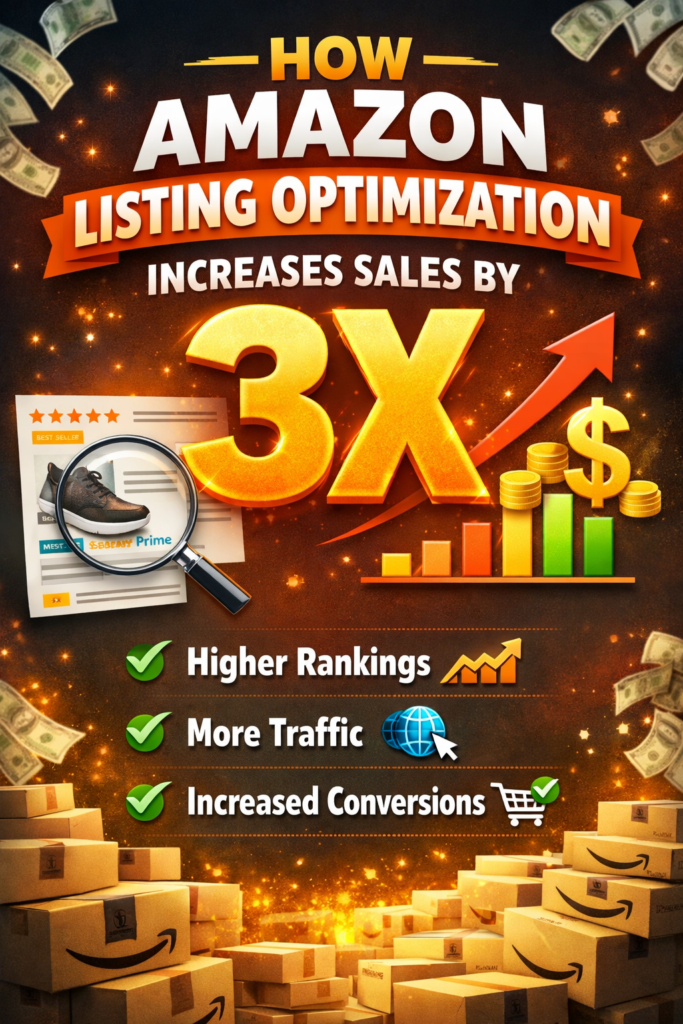
The 3X Sales Growth Formula: A Summary
Semantic Keywords Covered in This Strategy
The following semantic keyword clusters are integral to a complete Amazon listing optimization strategy and should be naturally incorporated across your listing:
Amazon SEO & Algorithm Keywords
• Amazon A9 algorithm, Amazon search algorithm, organic ranking, search relevance
• Keyword indexing, keyword ranking, search term coverage, ASIN indexing
Listing Content Keywords
• Product title optimization, bullet point copywriting, product description SEO
• Enhanced Brand Content (EBC), Amazon A+ Content, backend keywords
• Amazon listing copywriting, conversion copywriting, product detail page
Traffic & Conversion Keywords
• Amazon click-through rate (CTR), conversion rate optimization (CRO)
• Amazon Buy Box optimization, product discoverability, organic traffic
• Amazon Sponsored Products, PPC optimization, ROAS improvement
Business & Growth Keywords
• Amazon FBA optimization, Amazon seller strategy, ecommerce revenue growth
• Sales velocity, Best Seller Rank (BSR), Amazon marketplace optimization
• Product launch strategy, competitive differentiation, Amazon brand registry